
THE CINCINNATI TIMES-STAR
December 2, 1904
NEWS
scans from newspaper collection
of
Ruth
Adams-Battle
transcribed by Dorothy
Wiland

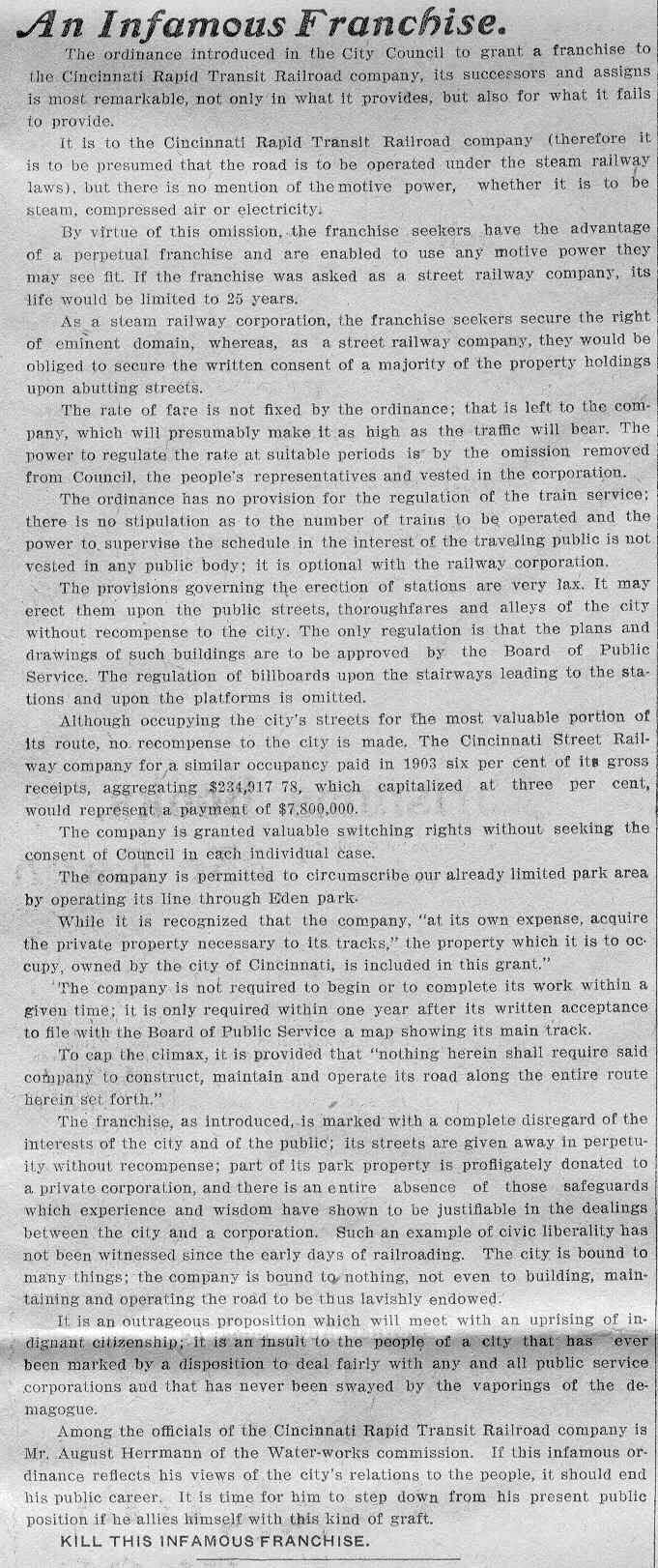
An Infamous Franchise.
The
ordinance introduced
in the City Council to grant a franchise to the Cincinnati Rapid
Transit
Railroad company, its successors and assigns is most remarkable, not
only
in what it provides but also for what it fails to provide.
It is to the Cincinnati
Rapid Transit Railroad company (therefore it is to be presumed that the
road is to be operated under the steam railway laws), but there is no
mention
of the motive power, whether it is to be steam, compressed air or
electricity.
By virtue of this omission,
the franchise seeker have the advantage of a perpetual franchise and
are
enabled to use any motive power they may see fit if the franchise was
asked
as a street railway company, its life would be limited to 25 years.
As a steam railway corporation
the franchise seekers secure the right of eminent domain, whereas, as a
street railway company, they would be obliged to secure the written
consent
of a majority of the property holdings upon abutting streets.
The rate of fare is not
fixed by the ordinance; that is left to the company, which will
presumably
make it as high as the traffic will bear. The power to regulate
the
rate at suitable periods is by the omission removed from Council, the
people's
representatives and vested in the corporation.
The ordinance has no provision
for the regulation of the train service there is no stipulation as to
the
number of trains to be operated and the power to supervise the schedule
in the interest of the traveling public is not vested in any public
body;
it is optional with the railway corporation.
The provisions governing
the erection of stations are very lax. It may erect them upon the
public streets, thoroughfares and alleys of the city without recompense
to the city. The only regulation is that the plans and drawings
of
such buildings are to be approved by the Board of Public Service.
The regulation of billboards upon the stairways leading to the stations
and upon the platforms is omitted.
Although occupying the
city's streets for the most valuable portion of its route, no
recompense
to the city is made. The Cincinnati Street Railway company for a
similar occupancy paid in 1903 six per cent of its gross receipts,
aggregating
$234,917, which capitalized at three per cent, would represent a
payment
of $7,800,000.
The company is granted
valuable switching rights without seeking the consent of Council in
each
individual case.
The company is permitted
to circumscribe our already limited park area by operating its line
through
Eden park.
While it is recognized
that the timpani, "at its own expense acquire the private property
necessary
to its tracks," the property which is to occupy, owned by the city of
Cincinnati,
is included in this grant."
The company is not required
to begin or to complete its work within a given time; it is only
required
within one year after its written acceptance to file with the Board of
Public Service a map showing its main track.
To cap the climax, it is
provided that "nothing herein shall require said company to construct,
maintain and operate its road along the entire route herein set forth."
The franchise, as introduced,
is marked with a complete disregard of the interests of the city and of
the public; its streets are given away I perpetuity without recompense;
part of its park property is profligately donated to a private
corporation,
and there is an entire absence of those safeguards which experience and
wisdom have shown to be justifiable in the dealings between the city
and
a corporation. Such an example of civic liberality has not been
witnessed
since the early days of railroading. The city is bound to many
things;
the company is bound to nothing, not even to building, maintaining and
operating the road to be thus lavishly endowed.
It is an outrageous proposition
which will eet with an uprising of indignant citizenship; it is an
insult
to the people of a city that has ever been marked by a disposition to
deal
fairly with any and all public service corporations and that has never
been swayed by the vaporings of the megogue.
Among the officials of
the Cincinnati Rapid Transit Railroad company is Mr. August Herrmann of
the Water-works commission. If this infamous ordinance reflects
his
views of the city's relations to the people, it should end his public
career.
It is time for him to step down from his present public position if he
allies himself with this kind of graft.
KILL THIS INFAMOUS FRANCHISE.
Back to:
December 2,
1904 Index
©2003, 2004 by Linda
Boorom & Tina Hursh