THE CINCINNATI TIMES-STAR
December 6, 1904
NEWS.
scans from newspaper
collection
of
Ruth
Adams-Battle
Transcribed by
Dorothy
Wiland

"Present Hospital Very Inadequate"
Said Dr. Holmes.
Patients Herded More
Like Cattle Than Human Beings.
Great Majority of
Medical
Staff in Favor of Hilltop Site.
Formal Statement Made
by Dr. Holmes Before the B. of P. S.
~~~~
Physicians Who Favor
Removal To Hilltop.
Statement as to
Sentiment
of Medical Fraternity.
Dr. C. R. Holmes,
president
of the new city hospital commission, in a formal statement addressed to
the Board of Public Service Monday, answered the statements made by Dr.
Fackler Friday to the effect that there are three wards standing empty
in the Cincinnati hospital to-day, and if these wards were occupied
there
would be room enough for 120 additional patients, which would give the
hospital all the additional room needed for a long time to come.
Replying to this statement of Dr. Fackler, Dr. Holmes said:
“Such a statement made
by the president of the medical staff should naturally carry much
weight
with it and justify the public in asking why build a new hospital if
these
are the facts. That the first part of this statement is in part
erroneous
and entirely misleading, and the last statement absolutely incorrect, I
shall prove by the following statement of facts and figures, the
correctness
of which I challenge anyone to prove otherwise. For, unless
explained,
it would give the impression to the public that these wards had been
standing
empty for lack of patients to fill them, when, as I shall show, two of
these were vacated by the nurses this summer in order to prepare them
for
patients.
“The three wards
referred
to are A, J and P. J is not empty; one-half of it is given up to
contagious diseases, while the other half is cut up into small rooms to
house the ward maids, two in each room, as there is absolutely no other
place to put these women. If they have to live outside it would
mean
considerable additional expense, and besides it is necessary for the
interest
of the service to have them directly under the housekeeper’s control;
that
reduces the empty wards under consideration to two.
“From the time the
hospital
was built till 1893, Wards A and P were used for private or pay
patients,
where any physician in Cincinnati, whether or not connected with the
hospital
staff, could take and attend his patients. But in 1893, when the
contract with the Society of the Cincinnati Training School for Nurses
was canceled (the nurses of said society did not reside in the
hospital)
and the hospital started a training school of its own, this ward was
occupied
by the Training school (Dr. Hendly was then the superintendent), so as
to give room for the growing number of nurses. While the rooms
had
only been intended for one patient, two nurses were placed in each,
thus
accommodating 28 nurses—the rest still sleeping in rooms of the various
wards. This condition existed till about two years ago, when the
increase of patients and nurse again demanded expansion, and it was
found
necessary to close Pay Ward A and put 28 nurses in there, this being in
one of the short buildings, giving a ward 88 feet long, which should
hold
only 24 patients.
“Thus 56 nurses were
provided
for; the balance still had to sleep in various parts of he
hospital.
The number of patients continued to increase till, during the winter of
1903-4 many of them slept on rows of mattresses placed upon the floor,
the population reaching its highest number on January 25, 1904, when
there
were 576 patients in the Twelfth street hospital and 118 at the branch,
and to the shame of Cincinnati, and to any one, physician or layman,
who
fails to recognize the injustice of such crowding.
There were 74
patients
crowded into E ward, medical, where, according to all rules of hospital
hygiene, there should be only 32! And two more in the small en d
rooms—34;
(these really should not be counted as one at least and under such
crowded
conditions both should be reserved for dying patients) thus leaving 40
more patients in this ward than should have existed. Ward B had
been
closed for the sake of economy, but then permission was granted to open
it—but even that failed to relieve the congestion to any extent.
“According to the
accepted
standard of hospital hygiene, there should have been only 24 beds in
the
following nine wards, each 88 feet long, i. e., B, C, G, H, I, J, K, L,
Q, R, and 32 in the 118 feet wards, D, E, F, M, N, O. Now if
every
bed were occupied bearing in mind that there should be only eight beds
for contagious diseases in south end J ward (the north end, as already
stated, being used for ward maids), there still were 190 more patients
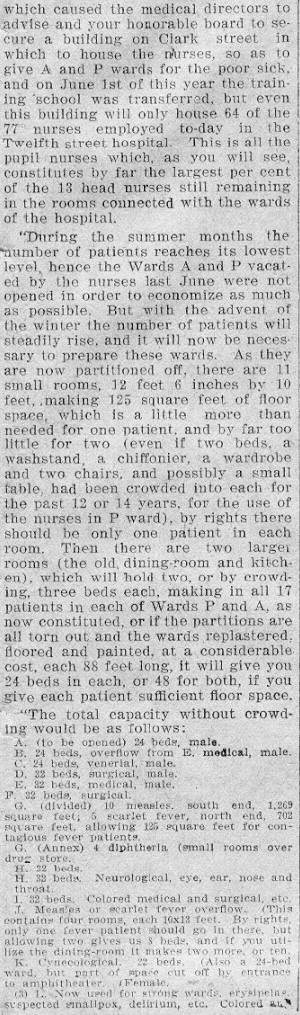
than beds. It was this condition which caused the medical
directors
to advise and your honorable board to secure a building on Clark street
in which to house the nurses, so as to give A and P wards for the poor
sick, and on June 1st of this year the training school was transferred,
but even this building will only house 64 of the 77 nurses employed
to-day
in the Twelfth street hospital. This is all the pupil nurses
which,
as you will see, constitutes by far the largest per cent of the 13 head
nurses still remaining in the rooms connected with the wards of the
hospital.
“During the summer
months
the number of patients reaches its lowest level, hence the Wards A and
P vacated by the nurses last June were not opened in order to economize
as much as possible. But with the advent of the winter the number
of patients will steadily rise, and it will now be necessary to prepare
these wards. As they are now partitioned off, there are 11 small
rooms, 12 feet 6 inches by 10 feet, making 125 square feet of floor
space,
which is a little more than needed for one patient, and by far too
little
for two (even if two beds, a washstand, a chiffonier, a wardrobe and
two
chairs, and possibly a small table, had been crowded into each for the
past 12 or 14 years, for the use of the nurses in P ward), by rights
there
should be only one patient in each room. Then there are two larger
rooms
(the old, dining-room and kitchen), which will hold two, or by
crowding,
three beds each, making in all 17 patients in each of Wards P and A, as
no constituted, or if the partitions are all town out and the wards
replastered,
floored and painted, at a considerable cost, each 88 feet long, it will
give you 24 beds in each, or 48 for both, if you give each patient
sufficient
floor space.
“The total capacity
without
crowding would be as follows:
A. (to be opened) 24
beds,
male
B. 24 beds, overflow
from
E. medical, male
C. 24 beds, venereal,
male
D. 32 beds, surgical,
male
E. 32 beds, medical, male
F. 32 beds, surgical
G. (divided) 10 measles,
south end, 1,269 square feet; 5 scarlet fever, north end, 702 square
feet,
allowing 125 square feet for contagious fever patients.
G. (Annex) 4 diphtheria
(small rooms over drug sore.
H. 22 beds
H. 33 beds.
Neurological,
eye, ear, nose and throat.
I. 32 beds. Colored
medical
and surgical, etc.
J. Measles or scarlet
fever overflow. (This contains four rooms, each 10 x 13 feet.
By
rights only one fever patient should go in there, but allowing two
gives
us 8 beds, and if you utilize the dining-room it makes two more, or ten.
K. Cynecological,(sic)
22 beds. (Also a 24-bed ward, but part of space cut off by entrance to
amphitheater. Female.
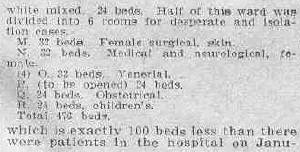
(3) 1. Now used for
strong
wards, erysipelas, suspected smallpox, delirium, etc. Colored and white
mixed. 24 beds. Half of this ward was divided into 6 rooms for
desperate
and isolation cases.
M. 32 beds. Female
surgical.
Skin.
N. 32 beds. Medical and
neurological, female
(4) O. 32 beds. Venerial
(sic)
P. (To be opened) 24 beds
Q. 24 beds. Obstetrical
R. 24 beds, children’s
Total 476 beds.
Which is exactly 100
beds
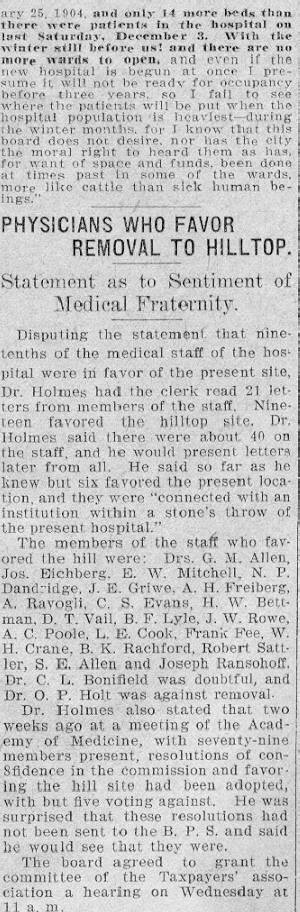
less than there were patients in the hospital on January 25, 1904. and
only 14 more beds than there were patients in the hospital on last
Saturday,
December 3. With the winter still before us! And there are no
more
wards to open, and even if the new hospital is begun at once I presume
it will not be ready for occupancy before three years, so I fail to see
where the patients will be put when the hospital population is
heaviest—during
the winter months, for I know that this board does not desire, nor has
the city the moral right to heard (sic) them as has, for want of space
and funds, b een done at times past in some of the wards, more like
cattle
than sick human beings.”
PHYSICIANS WHO FAVOR
REMOVAL
TO HILLTOP
Statement as to
Sentiment
of Medical Fraternity.
Disputing the
statement
that nine-tenths of the medical staff of the hospital were in favor of
the present site, Dr. Holmes had the a clerk read 21 letters from the
members
of the staff. Nineteen favored the hilltop site. Dr. Holmes said
there were about 40 on the staff, and he would present letters later
from
all. He said so far as he knew but six favored the present
location,
and they were “connected with an institution within a stone’s throw of
the present hospital.”
The members of the
staff
who favored the hill were: Drs. G. M. Allen, Jos. Eichberg, E. W.
Mitchell,
N. P. Dandridge, J. E. Griwe, A. H. Freiberg, A. Ravogli, C. S. Evans,
H. W. Bettman, D. T. Vaikl, B. F. Lyle, J. W. Rowe, A. C. Poole, L. E.
Cook, Frank Fee, W. H. Crane, B. K. Rachford, Robert Sattler, S. E.
Allen
and Joseph Ransohoff. Dr. C. L. Bonifield was doubtful, and Dr.
O.
P. Holt was against removal.
Dr. Holmes also
stated
that two weeks ago at a meeting of the Academy of Medicine, with
seventy-nine
members present, resolutions of confidence in the commission and
favoring the hill site had been adopted, with but five voting
against.
He was surprised that these resolutions had not been sent to the B. P.
S. and said he would see that they were.
The board agreed to
grant
the committee of the Taxpayers’ association a hearing on Wednesday at
11
a.m.
Back to:
December
6, 1904 Index
©2003, 2004 by Linda
Boorom & Tina Hursh