
THE CINCINNATI TIMES-STAR
December 6, 1904
TOLD ABOUT AND BY PEOPLE YOU KNOW
scans from newspaper collection of
Ruth Adams-Battle
transcribed by Dorothy
Wiland

TOLD ABOUT AND BY PEOPLE YOU KNOW
transcribed by Dorothy
Wiland
TOLD ABOUT AND BY PEOPLE YOU KNOW
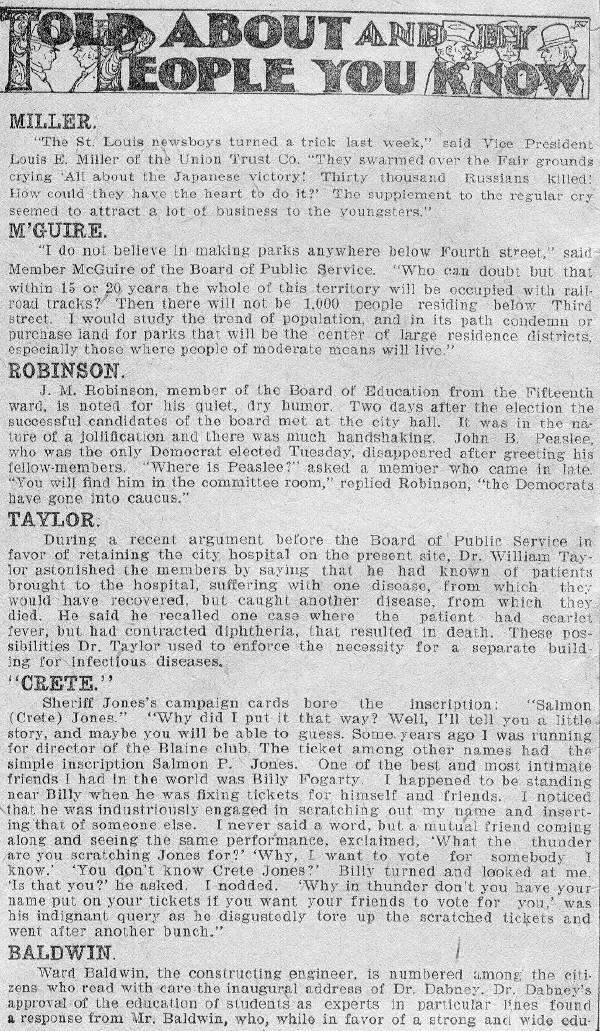
M’GUIRE
“I do not believe in making
parks anywhere below Fourth street,” said Member McGuire of the Board
of
Public Service. “Who can doubt but that within 15 or 20 years the
whole of this territory will be occupied with railroad tracks?
Then
there will not be 1,000 people residing below Third street. I
would
study the trend of population, and in its path condemn or purchase land
for parks that will be the center of large residence districts,
especially
those where people of moderate means will live.”
ROBINSON
J. B. Robinson, member
of the Board of Education from the Fifteenth ward, is noted for his
quiet,
dry humor. Two days after the election the successful candidates
of the board met at the city hall. It was in the nature of a
jollification
and there was much handshaking. John B. Peaslee, who was the only
Democrat elected Tuesday disappeared after greeting his
fellow-members.
“Where is Peaslee?” asked a member who came in late. “You will
find
him in the committee room” replied Robinson, “the Democrats have gone
into
caucus.”
TAYLOR
During a recent argument
before the Board of Public Service in favor of retaining the city
hospital
on the present site, Dr. William Taylor astonished the members by
saying
that he had known of patients brought to the hospital, suffering with
one
disease, from which they would have recovered, but caught another
disease,
from which they died. He said he recalled one case where the
patient
had scarlet fever, but had contracted diphtheria, that resulted in
death.
These possibilities Dr. Taylor used to enforce the necessity for a
separate
building for infectious diseases.
“CRETE”
Sheriff Jones’s campaign
cards bore the inscription: “Salmon (Crete) Jones.” “Why did I
put
it that way? Well, I’ll tell you a little story, and maybe you will be
able to guess. Some years ago I was running for director of the
Blaine
club. The ticket among other names had the simple inscription
Salmon
P. Jones. One of the best and most intimate friends I had in the
world was Billy Fogarty. I happened to be standing near Billy
when
he was fixing tickets for himself and friends. I noticed that he
was industriously engaged in scratching out my name and inserting that
of someone else. I never said a word, but a mutual friend coming
along and seeing the same performance, exclaimed, ‘What the thunder are
you scratching Jones for?’ ‘Why, I want to vote for somebody I
know.’
‘You don’t know Crete Jones?’ Billy turned and looked at
me.
‘Is that you?’ he asked. I nodded. ‘Why in thunder don’t
you
have your name put on your tickets if you want your friends to vote for
you,’ was his indignant query as he disgustedly tore up the scratched
tickets
and went after another bunch.”
BALDWIN
Ward Baldwin, the constructing
engineer, is numbered among the citizens who read with care the
inaugural
address of Dr. Dabney. Dr. Dabney’s approval of the education of
students as experts in particular lines round a response from Mr.
Baldwin,
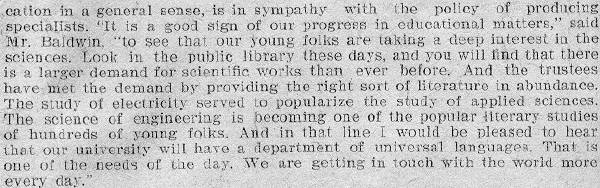
who, while in favor of a strong and wide education in a general sense,
is in sympathy with the policy of producing specialists. “It is a good
sign of our progress in educational matters, “said Mr. Baldwin, “to see
that our young folks are taking a deep interest in the sciences.
Look in the public library these days, and you will find that there is
a larger demand for scientific works than ever before. And the
trustees
have met the demand by providing the right sort of literature in
abundance.
The study of electricity served to popularize the study of applied
sciences.
The science of engineering is becoming one of the popular literary
studies
of hundreds of young folks. And in that line I would be pleased
to
hear that our university will have a department of universal
languages.
That is one of the needs of the day. We are betting in touch with
the world more every day.”
©2003, 2004 by Linda Boorom & Tina Hursh