Biography of Colonel W. H. Hill
with
Portrait of Wm. H. Hill
pages 394-396, portrait facing page 394
transcribed by Linda Boorom

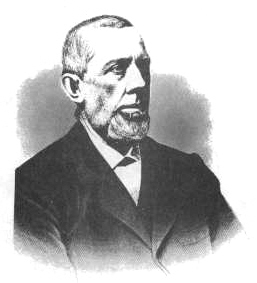
Wm. H. Hill
Colonel W. H. Hill
Colonel W. H. Hill
In 1862, while Colonel HILL was in the milling business, when the great war of the Rebellion was fully inaugurated, and all the loyal sons of the United States were preparing to defend our flag, he was among the first to settle his business, enroll his name and organize a company, which was embodied in the Eighty-first regiment of Ohio volunteer infantry. He was chosen captain of company A, after which he was promoted to lieutenant colonel of the same regiment, and breveted colonel on the twelfth day of August, 1864. While in the line of his duty in front of Atlanta, Colonel HILL received a gun-shot wound in the left hand and was sent to the hospital in Cincinnati. Before he had sufficiently recovered to return to his regiment he was assigned to duty on a court-martial. As soon as he was relieved from that duty, on his own application after having been offered a discharge, he returned to his regiment, joining it at Goldsborough, North Carolina, and remained with it until the war closed with the surrendering of General LEE. He was then mustered out with his regiment at Camp Dennison. He entered the service at the commencement of the war, as before noticed, with the rank of captain, and attained the position of lieutenant colonel with a brevet colonel's rank. His war record is one of which he and his friends are justly proud. Very few men who drew their swords at the commencement of that terrible struggle served their country with greater devotion through the entire Rebellion, from 1862, than did the gallant officer whose name stands at the head of our biographical sketch. On returning to civil life he found thousands of soldiers who, for various reasons, had not yet received the money due them from the United States, and, upon their solicitation, he opened, in Cincinnati, a war-claim and real estate office and was enabled greatly to aid the noble defenders of the country to collect their dues and secure pensions. It is safe to say that no claim attorney in the State had a larger business.
In the spring of 1868, after suffering from a disease he had contracted in addition to his wound in the service, he removed to a farm in Butler county, where he remained until 1870, when he moved to his valuable farm in Sycamore township, his present and no doubt future residence. During the last eleven years he has been largely engaged in farming. Beyond question Colonel HILL has grown more wheat per acre on his farm for the last three years than any other farmer in his township. In August, 1873, he assisted in organizing Eden Grange, No. 97 Patrons of Husbandry, being one of the charter members. When the Hamilton County council was instituted Colonel HILL was chosen as its first business agent, without compensation for the first year; and so well were its operations organized by him that on the twenty-ninth of July, 1874, after the council had become thoroughly organized, he was appointed financial business manager of the Ohio State grange by the State grange executive committee. He accepted the trust under protest, after having repeatedly declined and requesting others to be appointed. Locating his office at Sharonville, in a room but eight by ten feet in dimensions, business increased so rapidly that it became necessary to open another house in Cincinnati, Which was done April 1, 1875, with local agents in various parts of the State. On the first day of October, 1875, the business had become so extensive, running over millions of dollars, a large warehouse was opened at No. 63 Walnut street, after which a still larger house had to be secured at 22 and 24 East Third street, with business so largely on the increase that he had to enlarge his clerical force until he retired with an increased salary offered him, February 11, 1881.
In 1874 Colonel HILL was a candidate on the Republican ticket in Hamilton county for the office of county commissioner; and although he was not elected, he ran much ahead of his ticket, and his popularity in his own township was so great that he received almost the entire vote of his own precinct In 1877 he was unanimously elected to the presidency of the Hamilton County Agricultural society, and took charge January 1, 1878, when the society was at its lowest ebb, not paying more than thirty to fifty per cent on its debts and premiums. When Colonel HILL with the board reorganized, they managed to get the Patrons of Husbandry and farmers interested, so that his first fair (that of 1878), after renovating the old buildings and trimming up the grounds, enough was taken in to pay all premiums and nearly all expenses of improvements made. This success so encouraged Colonel HILL and the board, that on his second election he went to work to raise funds to rebuild, but did not succeed in getting enough to put the grounds in proper order. But the fair of 1879, like that of 1878, was a pronounced success, realizing funds sufficient to pay all premiums and debts. He was again, for the third time, elected president, and then prepared a bill and got it through the Ohio legislature, of which he was by this time a member, appropriating fifteen thousand dollars for the purchase of more grounds and improving the same, which was done during the summer of 1880, putting the grounds in such shape for that year that it was the greatest success of any fair ever held in the county. He was once more reelected, now for the fourth term, by a unanimous vote. At this fair the association accumulated funds enough to pay all premiums and debts, and as the reports will show, had a surplus with rental of the grounds and State free, of three hundred to eight hundred dollars. Colonel HILL then drew up another bill and got an appropriation of ten thousand dollars, which will enable him and the board to make the Hamilton county fair grounds the finest of any in the State.
In the fall of 1879 Colonel HILL was elected one of the Hamilton county delegation to the Sixty-fourth general assembly of the State legislature, running the second highest on the ticket. Upon the organization of the committees of the house, Colonel HILL was made chairman of the agricultural committee, and also put on the committee on turnpikes. As a legislator he was always on hand, and attentive to the interests of his constituents, very seldom losing a bill he presented to the house. On the sine die adjournment of the assembly, and returning home to his constituents, he opened, in connection with Colonel Thomas E. SPOONER, his old book-keeper when in charge of the State Grange house, an agricultural warehouse and general commission business, at Nos. 13 and 15 East Third street, Cincinnati, which, from present indications, will increase as largely as his State grange business did.
Colonel HILL's connection with the financial business of the county and State granges, and his success with the Hamilton County Agriculturial society since it came under his charge, has given him a county, State and national reputation among the patrons of husbandry, and among farmers and business men generally, such as any man can be proud of. While a member of the legislature, in addition to the large amount of work sent him from his county and from the State at large, he secured for the State Agricultural society a larger appropriation than it had ever received before.
Colonel HILL has long been closely interested in the education of the youth of his locality; has had charge of the management of the satire in Sharonville for several years, and in his efforts to bring them to a higher standard and the establishment of graded schools, so that the children of the poor as well as the rich can be educated, is only waiting time to accomplish it. This, like the rest of his undertakings, will certainly be accomplished in due time.
September 8, 1849, Colonel HILL was married to Charlotte L. KELLEY, at Winchester, Indiana. Nine children have been born of this union, of whom only six are now living.
Back to:
Biographical
& Illustrations Index
History of Hamilton
Co. Index
Hamilton Co.,
OHGenWeb
©2003 by Linda Boorom