Washington Park ca. 1908
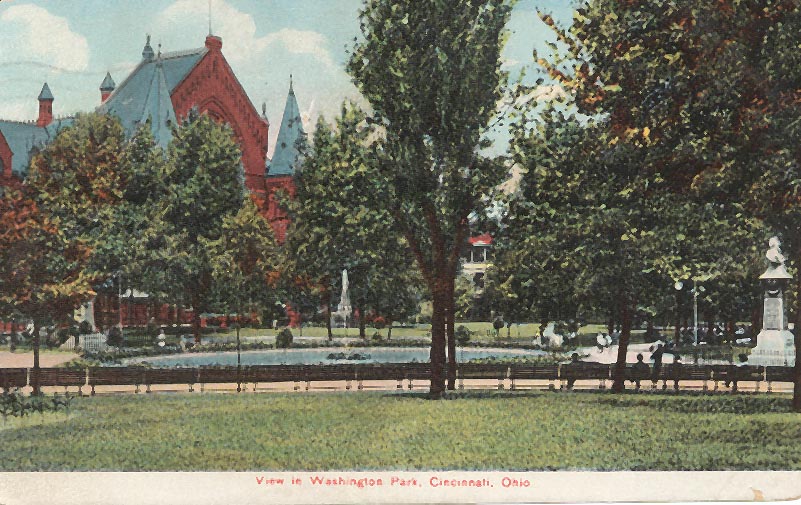
From the personal collection of Patti
Graman.
From the personal collection of Patti
Graman.
Washington Park is located in the heart of the
Over-the-Rhine
section - which should bring fond memories and tales of gay Old
Cincinnati.
Here the ladies stepped from their carriages in fashionable ruffles and
carrying parasols in the late 19th and early 20th centuries to attend
band
concerts at Washington Park. Here the neighbors gathered on hot nights
seeking relief in cool park breezes.
At Elm, Race, and Twelfth Streets, Washington Park's 5.61 acres still
give
relief from summer heat to neighbors in the crowded downtown area.
The park, a stone's throw from Music Hall, has seen the gayest whirl of
Old Cincinnati, especially during the Fall Festivals, when gondolas
plied
up and down the canal and spectacles and extravaganzas were set up.
"The
Centennial Exposition of the Ohio Valley and Central States" was held
here
in 1888 with great success. It was, in addition to the celebration of
Ohio's
remarkable progress, designed to celebrate the settlement of the
Northwest
Territory, which gave it further national significance. Buildings
occupied
a large part of Washington Park and spanned the canal. Floor space was
devoted to
industrial and art
exhibits
and hundreds of thousands of people thronged the streets. Washington
Park,
at this moment of display, was the center of art and business endeavor
and the showcase of the Middle West. The Exposition was held in a huge
building and, with additions, the exhibiting space covered seven
acres.
Parcels comprising Washington Park were purchased in 1855, 1860, and
1863.
The first two parcels had been used for cemeteries. Memorials include a
monument to General F. Hecker, German-American patriot, this monument
having
been dedicated in 1883 by citizens of German birth and ancestry; a
monument
to R.L. McCook of the 9th Regiment of the Ohio Volunteer Infantry, in
1878,and
bronze tablet, 1931, given by Sons and Daughters of the 9th O.V.I.;
a
drinking fountain memorial in honor of a labor leader, Frank L. Rist,
erected
in 1920 by the Committee of Central Labor Council, and a Civil War
cannon
used by Admiral Farragut in Mobile Bay. This cannon, like the Indian in
Thornton Triangle, almost went to war during the
scarcity
of scrap metal in World War II, but was preserved through the efforts
of
the Hamilton County Memorial Association, a federation of the G.A.R.
The
Park's bandstand was erected in 1911. The drinking fountain memorial is
no longer there; however, the large meteorite
remains.
Back
to:
Pictures
Hamilton
Co., OH Main Page
©2000 by Tina
Hursh